Integrated Pest Management
Our ISA Certified Arborists® identify pests and disease before they cause serious damage, and build targeted treatment plans that protect your trees without unnecessary chemical use.
Contact Us
How We Do It
Customized tree care plans
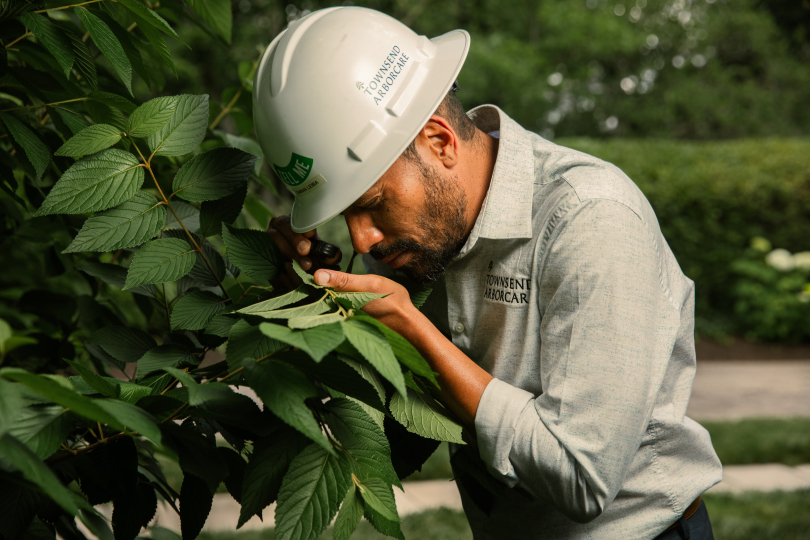
Step 1: Every integrated pest management (IPM) engagement starts with an on-site inspection. Our ISA Certified Arborists evaluate your trees and shrubs for active pest activity, disease symptoms, and conditions that create vulnerability—including soil stress, structural issues, and species-specific risk factors common to Central Indiana.
Step 2: From that assessment, we identify what's present, what's at risk, and what the correct intervention is. Treatment is selected based on the pest, its life cycle stage, and the severity of infestation.
Step 3: Depending on our findings, we may recommend injections, trunk sprays, pruning, or control methods that work with the surrounding ecosystem rather than against it.
WHY WE DO IT
Organic tree pest control
Most pest and disease damage to trees is well underway before it becomes visible. Integrated pest management is designed to close that gap—using regular tree inspections, early identification, and targeted treatments timed to pest life cycles rather than applied on a reactive schedule. The IPM approach also means chemical treatments are used selectively.
Benefits from the ground up
IPM specialists
Our arborists are trained to identify common Indiana pests correctly and to distinguish pest damage from drought stress, nutrient deficiency, or mechanical injury that can present similarly.
Treatment options
Once a pest is correctly identified, we match the treatment method to the pest.
Regular monitoring
Townsend Arborcare's ISA-certified arborists can establish a scheduled monitoring program so that pest populations are caught early and treatments stay ahead of the damage threshold.
Frequently Asked Questions About Integrated Pest Management
Integrated pest management (IPM) is a systematic approach to tree pest control that combines regular monitoring, accurate pest identification, and targeted treatments selected based on the specific pest, its life cycle, and the level of infestation. Rather than applying pesticides on a fixed calendar schedule, IPM uses inspection data to determine if, when, and what type of treatment is actually needed. The goal is effective pest control with minimal impact on surrounding plants, beneficial insects, and the environment.
Indianapolis properties commonly deal with emerald ash borer, bagworms, scale insects, aphids, tent caterpillars, and various tree borers.
Common indicators include canopy thinning or dieback: yellowing or discolored leaves outside of fall: sawdust or frass around the base of the tree: visible webs or tenting in the canopy: bark that is splitting, oozing, or showing pitch tubes: and abnormal early leaf drop.
Yes. Ash trees that retain more than 50% of their canopy can typically be protected with systemic insecticide treatment. We assess the tree’s current health, canopy coverage, and site conditions to determine whether treatment is viable and what product and application method is appropriate.
Integrated Pest Management for Indianapolis Properties
Central Indiana's tree canopy faces a specific set of pest and disease pressures, including emerald ash borer, which has been active in Indiana since 2004 and continues to threaten unprotected ash trees in Indianapolis, Carmel, Fishers, and the surrounding communities. Townsend Arborcare's arborists have worked throughout this region for over 60 years and understand the local pest calendar, the species most at risk, and how seasonal conditions in Indiana affect pest activity and treatment timing.